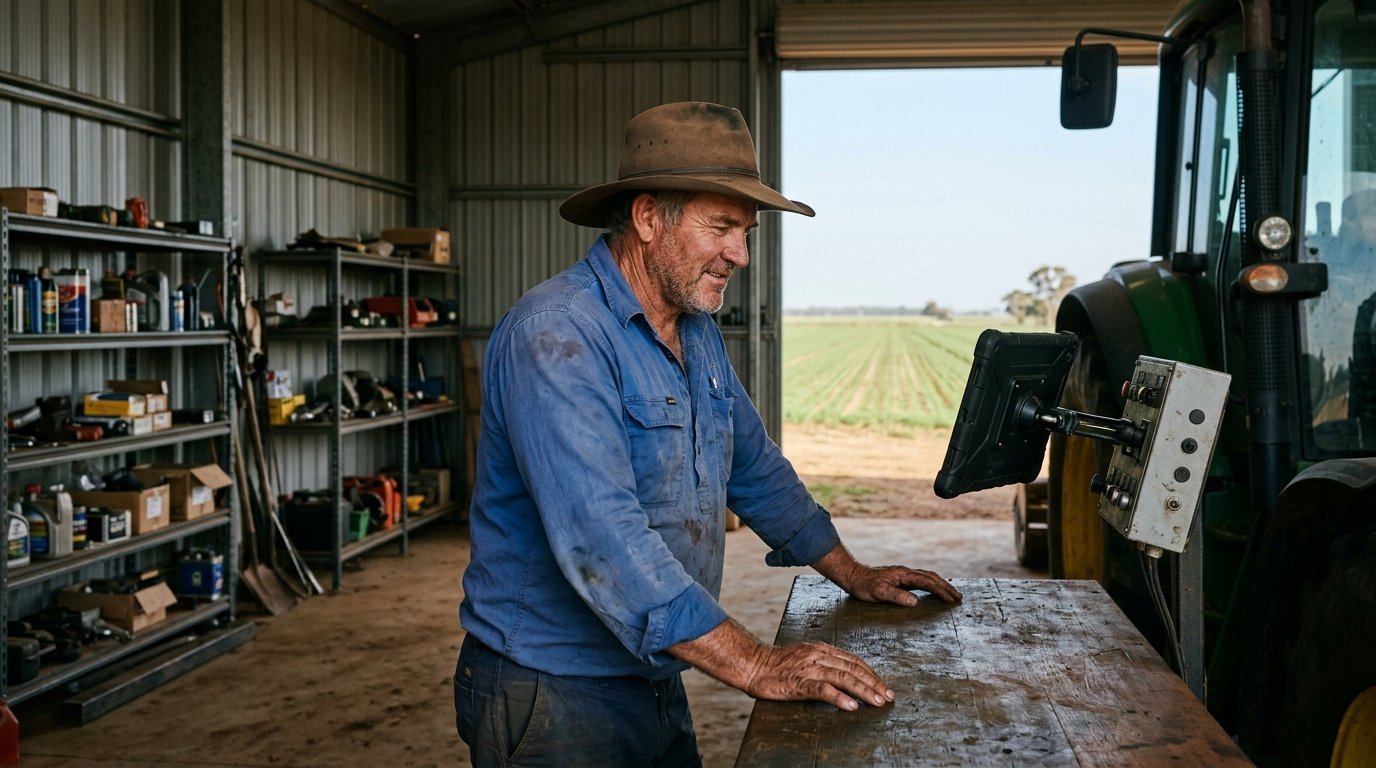
Australian agriculture’s shift toward connected technology, including GPS-guided machinery, automated irrigation, remote sensors and farm-management software, has created an attack surface that industry experts describe as enormous, dispersed and largely unmonitored.
The warning, published on 19 October 2026 by Australian Community Media, follows a cyberattack in France where hackers exploited unpatched firmware in refrigeration systems to spoil food across hundreds of supermarkets. The incident has sharpened focus on the security of Australia’s agricultural supply chain as the federal government develops its first National Food Security Strategy, covering a $100 billion industry.
The Scale of Exposure
Cyber security partner at RSM Australia, Ashwin Pal, who has 30 years of industry experience, told ACM that roughly one in 10 businesses across the food supply chain that experience a cyber incident do not report it. He said most supply-chain participants do not believe they are a target, lack the knowledge to secure the technology they are running, and in many cases do not know they are using it.
“The sector runs through tens of thousands of small, often family-owned operations with no dedicated IT staff, limited budgets, and heavy reliance on consumer-grade technology and third-party platforms,” Pal said. “In a supply chain context, that creates a practical exposure where a sophisticated actor can target the weakest participant and still cause disruption at scale.”
Australia has already experienced significant incidents. A 2021 attack on global meat processor JBS temporarily shut facilities in Australia, the United States and Canada. A 2020 attack on Talman Software disrupted wool auctions and exports across much of the Australian and New Zealand wool industry. In June 2026, Mackay Sugar reported a cyber security incident claimed by Russian ransomware group The Gentlemen, which crippled supply, harvesting and milling operations for more than two weeks and forced a shift to limited manual crushing.
What an Attack Looks Like on a Farm
The article notes that a cyber incident does not always resemble the high-profile corporate breaches that make headlines. For a farm business, it can mean:
- Loss of access to financial or production records
- Inability to use a software platform at a critical operational moment
- Interruption to automated irrigation during a high-stress period
- Failure of machinery guidance or harvesting software
- A supplier’s systems going offline when inputs or logistics are needed
CSIRO researcher Dr Chandra Thapa also warned that aggregated agricultural data, including yield, water use, animal health records, machinery settings and business correspondence, can expose production costs, likely harvest volumes and periods of financial pressure over time, potentially weakening a grower’s negotiating position with buyers and processors.
AI Compounds the Problem
The growing integration of AI in farm management introduces a further layer of risk. Where an AI agent has been granted authority across multiple systems, a compromise can have cascading effects. The article gives the example of an agent authorised to read crop and weather data, adjust irrigation schedules, order inputs and approve small invoices. If compromised during a heatwave, such a system could alter watering at the worst possible time, place unnecessary orders at elevated prices, or redirect payments while appearing to operate normally.
Dr Thapa advised businesses to begin with AI systems in read-only or advisory mode, restrict access to essential functions only, and require human approval for any consequential actions.
The Australian Signals Directorate acknowledged that AI has increased the speed and scale of threats, but noted many incidents still exploit known, unpatched weaknesses. Its practical recommendations include:
- Enabling multi-factor authentication or passkeys on all accounts
- Applying software updates promptly
- Maintaining tested, offline backups
- Running regular staff awareness on phishing and social engineering
- Independently verifying any changes to payment details before processing
Government Response and Funding
The federal government’s National Food Security Strategy, titled Feeding Australia, is due for release in mid-2027. The National Food Council, established in November 2025, is advising on the strategy and has already considered supply-chain resilience, including exposure to geopolitical disruption affecting fuel, fertiliser and freight. Ashwin Pal has argued that cyber security should be explicitly incorporated into the strategy.
Agriculture Minister Julie Collins pointed to $60 million in funding under the 2023-2030 Australian Cyber Security Strategy as support for businesses across the food supply chain to upgrade systems, access free training, complete cyber health checks and implement protective practices. The Cyber and Infrastructure Security Centre issued sector-specific guidance in 2023 recommending an all-hazards approach to risk assessment for food and grocery operations.
What This Means for WA Operators
Agritourism businesses sit at a specific intersection of this risk. Many WA operators run booking platforms, payment systems, online farm-management tools and guest communication software simultaneously, often without dedicated IT support and on general-purpose consumer accounts. Each of those connections is an entry point.
The supply-chain framing in this article is directly applicable. If the software platform managing your bookings, your point-of-sale, your irrigation scheduling or your livestock monitoring is compromised, the disruption hits you regardless of whether the attack originated on your property. The Talman wool-software incident in 2020 is a useful reference: operators who had no security failings of their own still lost access to critical systems because a third-party platform they depended on was the target.
Practical actions WA agritourism operators should review now:
- Audit every third-party platform your business depends on, including booking engines, accounting software, irrigation controls and communication tools. Confirm that each has multi-factor authentication enabled on your account.
- Establish what you would do operationally if any one of those platforms went offline for two weeks. Mackay Sugar’s manual-crushing fallback is a useful model: what is your manual fallback for bookings, payments and guest communications?
- Treat payment detail changes from any supplier or contractor as requiring independent phone verification before processing. This is one of the most common and costly attack vectors for small businesses.
- If you are moving toward AI-assisted farm management, start in read-only or advisory mode as Dr Thapa recommends, and do not grant automated purchasing or payment authority until you have tested the system thoroughly.
- The $60 million in federal funding under the Australian Cyber Security Strategy includes free cyber health checks for small businesses. Contact the Australian Cyber Security Centre at cyber.gov.au to confirm current availability and eligibility for your operation.
The broader lesson from the French refrigeration attack is not that digital tools should be avoided. It is that unpatched, internet-exposed systems with no fallback plan are a business continuity risk, not just an IT problem. For WA agritourism operators running seasonal, weather-dependent, visitor-facing businesses, a two-week operational disruption at peak season carries costs well beyond the immediate incident.
WAAA is monitoring the development of the Feeding Australia strategy and will engage with the consultation process to ensure agritourism operators are recognised within the supply-chain resilience framework.