
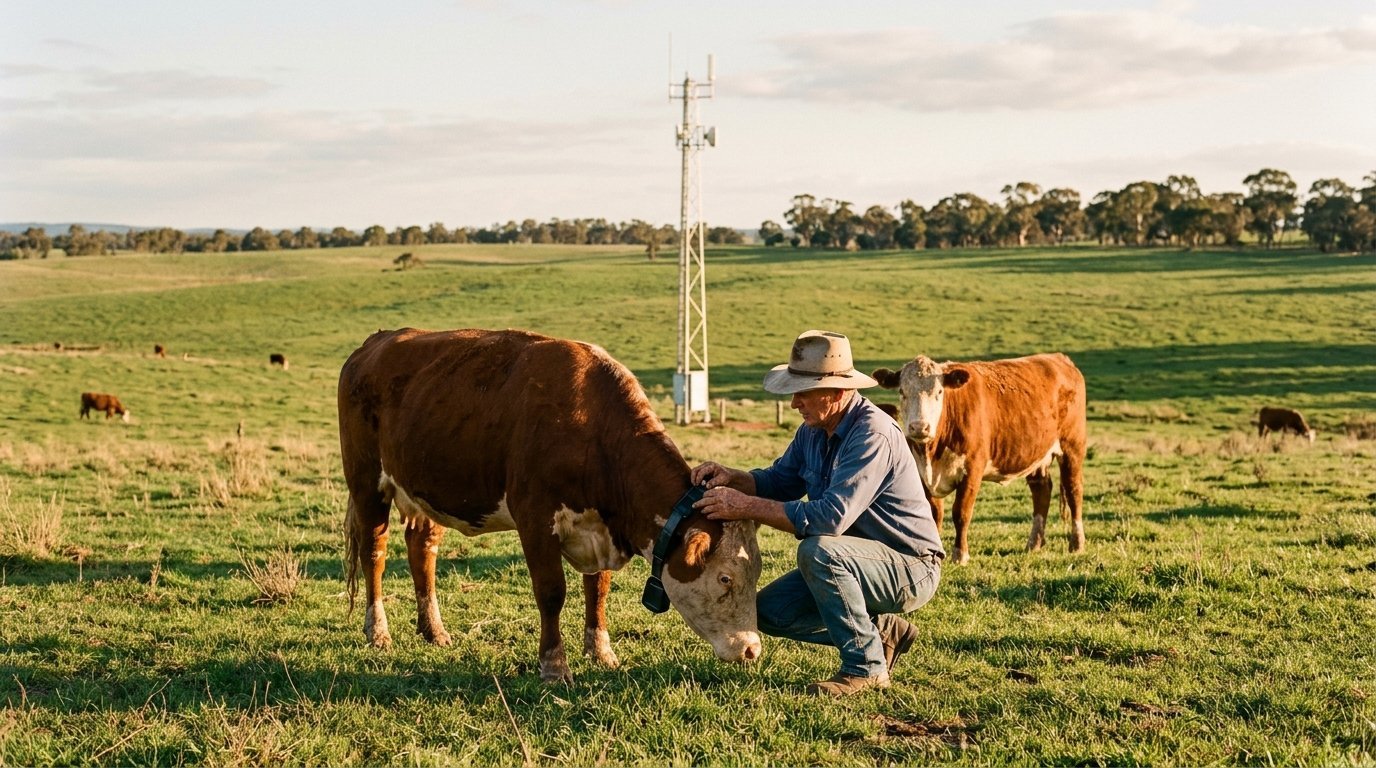
Regulatory changes that took effect across most of Australia in 2026 have opened a commercial market for virtual fencing technology that was previously restricted in Western Australia and unavailable at all in New South Wales, Victoria, and South Australia until earlier this year. For livestock operators who also run agritourism enterprises, the technology carries direct implications for how they manage stock movement, pasture presentation, and visitor safety on working properties.
What Changed and When
Until this year, commercial use of virtual fencing collars was lawful only in Tasmania, Queensland, the Northern Territory, and partially in Western Australia. New South Wales and Victoria approved commercial deployment in early 2026, and South Australia followed by July 2026. The regulatory shift has triggered rapid commercial uptake, with New Zealand-based Halter reporting more than 1,100 Australian farm sign-ups, a number driven largely by the newly opened mainland markets.
Western Australia’s partial approval predates the eastern states, meaning WA operators are not entering unfamiliar territory. Some will already have exposure to the technology or have monitored its Tasmanian and Queensland rollout closely.
The Technology and Its Costs
Two systems dominate the Australian market.
Halter, headquartered in New Zealand, uses GPS-guided collars linked to solar-powered signal towers. Key cost and operational details:
- Collars cost approximately $100 per animal per year, depending on the service package selected.
- Signal towers stand nine metres tall, cost approximately $3,000 each, and are positioned across the property based on size, topography, and tree cover.
- Stock and producers require up to two weeks of hands-on training to become operational.
- Collar batteries run for up to 10 weeks without sunlight.
- Satellite connectivity, currently used in overseas markets, is expected to be available in Australia in the first half of 2027.
- Halter currently operates on more than 4,000 farms across New Zealand, North America, and Australia.
Gallagher’s eShepherd system was developed in Australia by Melbourne-based Agersens in collaboration with CSIRO over nearly a decade. Gallagher acquired full control of the business in 2021. Key details:
- Neckbands are priced at $350 each, plus a $2.50 per animal monthly data fee charged only when the technology is in active use, meaning producers who destock in dry years or who run variable stock numbers are not charged during idle periods.
- Cellular base stations are six metres tall, transportable, and cost $6,000 to establish.
- The neckband battery has a working life of seven to ten years and requires four hours of sunlight to fully charge, providing two weeks of operation from a single charge.
- More than 100,000 neckbands have been sold across Australia, New Zealand, Europe, North America, and South America.
International Competitors
Several overseas players are also active or expanding:
- Vence (United States), owned by Merck Animal Health since 2022, charges approximately $US10,000 per base station with coverage of up to 60 kilometres, and leases collars at approximately $US50 each. Vence promoted its brand in Australia but ceased local marketing activity during mid-2026.
- Nofence (Norway) offers collars for cattle, sheep, and goats via cellular and satellite connectivity, and claims more than 10,000 customers globally. Its platform includes on-heat and calving detection alongside grazing management. It monitored operations across more than 24 million hectares in 2025.
- Corral Technologies (Nebraska, United States) sells collars directly to producers for $US250 each, with a $US50 annual subscription per animal that includes a lifetime warranty.
- Agrivanna (Canada) is developing satellite-enabled virtual fencing designed specifically for areas that are uneconomical to fence, including leased land, creek beds, and hill country.
What This Means for WA Operators
For agritourism operators running livestock alongside visitor experiences, virtual fencing addresses several practical problems at once.
Stock presentation is a constant operational tension. Rotational grazing managed through an app rather than physical mustering allows operators to move animals into paddocks visible from accommodation, dining areas, or walking trails on a schedule that suits visitor programming rather than labour availability. The Gallagher eShepherd’s transportable base station is particularly relevant for operators whose visitor zones shift seasonally.
Visitor safety on working properties depends partly on reliable stock containment. Virtual boundaries can be configured to exclude stock from high-traffic visitor areas without permanent infrastructure, which matters on properties where fencing competes aesthetically with the rural experience being sold.
The variable cost structure of eShepherd, where data fees are only charged when the system is active, suits the seasonal revenue patterns common in agritourism. Operators who carry fewer animals through a quiet visitor season or a dry period are not locked into fixed technology costs during those months.
WA operators considering either system should weigh the tower or base station density required for their specific property. Tree cover and broken topography, both common in parts of the South West and Great Southern, will affect coverage and therefore capital cost in ways that flat open country does not. Satellite connectivity, expected in Australia in the first half of 2027, may reduce that infrastructure requirement significantly for larger or more complex properties.
The regulatory position in WA has been partially permissive for longer than in the eastern states, so operators here are better placed than most to move quickly. Connecting with other WA livestock operators who have already trialled the technology is the fastest way to pressure-test vendor claims against local conditions. WAAA’s member forum and mentorship program exist precisely for that kind of peer-to-peer intelligence sharing, and the Professional Support Network can help identify advisers with direct experience of the technology in WA contexts.