
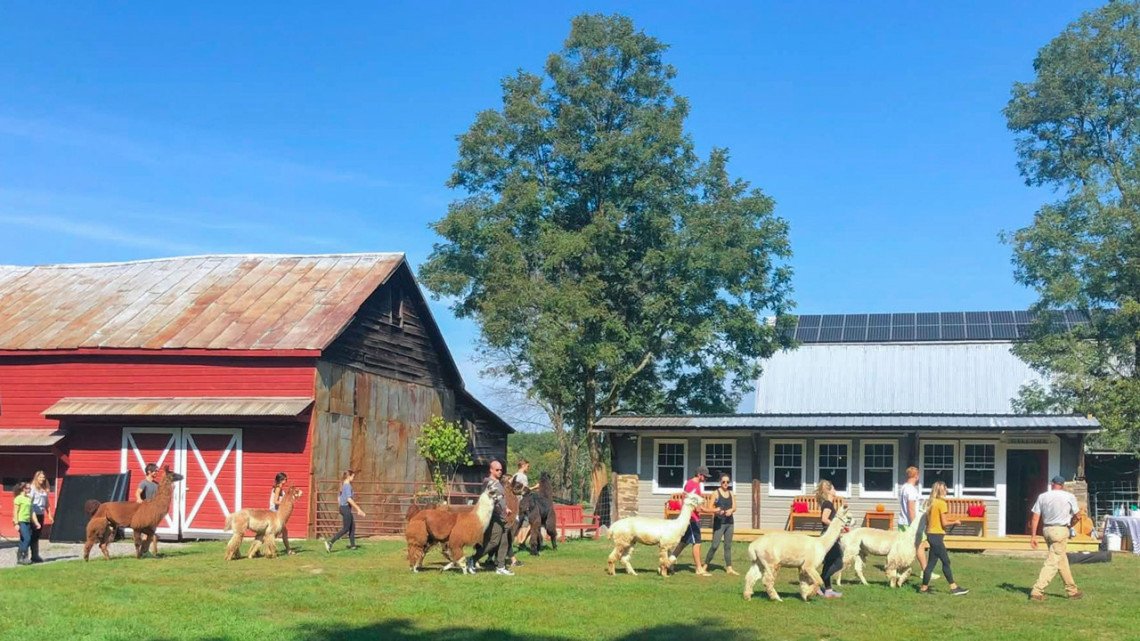
Agritourism activity in New York state has more than tripled since 2007, with nearly 1,000 farms generating $55.5 million in revenue as of 2022, according to the United States Department of Agriculture Census of Agriculture. The growth has prompted Cornell Cooperative Extension (CCE) to significantly expand its dedicated support for farm-based tourism operators, building a statewide infrastructure of education, peer networking, and business development resources.
Scale, Structure, and the CCE Support Model
CCE’s agritourism support program has accelerated markedly since 2020. In the three years to September 2026, CCE has produced more than 40 recorded webinars with accompanying fact sheets covering topics including tax obligations, liability management, grant writing, and experience design. A working group of more than 80 CCE educators, operating across county offices, has coordinated farm tours and peer-connection events across the state.
The program culminated in an inaugural statewide agritourism conference held in 2025 in Saratoga Springs, New York. A second conference is scheduled for 4-5 November 2026 at Cornell AgriTech in Geneva, New York.
Lindsey Pashow, CCE agricultural business development marketing specialist and agritourism statewide specialist, describes agritourism as a revenue diversification tool that simultaneously connects farmers with their local communities. Pashow acknowledges the operational difficulties that come with opening a working property to the public: navigating local government planning requirements, managing liability exposure, and maintaining control over how visitors behave on-farm are cited as recurring pressure points for operators entering the sector.
Operator Profiles: Diversified Experiences Anchored to Working Farms
Clover Brooke Farm in Hyde Park, New York illustrates the growth trajectory CCE is supporting. Owner Andrea Parent-Tibbetts built the property from a neglected plot with a small number of sheep and llamas into an operation hosting 5,000 visitors per year over a ten-year period. The farm’s product mix includes llama and alpaca hikes, yoga sessions, soap and loofah-making workshops, crafts, and farm tours. Parent-Tibbetts credits CCE support with helping her maintain strategic focus as the business scaled.
“There are so many aspects of your business, and you can go down a rabbit hole really easily,” Parent-Tibbetts said. “You need to stay at a macro level and at the same time juggle all the micro aspects.”
A second case study comes from Broome County, where first-time farmer Steven Marion established Farm in Broome after purchasing a previously defunct property. Marion’s model is built around farm stays designed to give guests distance from technology. Marion had no prior farming experience and no existing connections in the region when he started, and describes CCE’s role as critical to understanding the local regulatory and community environment before launch.
Agritourism as a Farmland Retention Tool
The New York data presents a striking structural contrast. Between 2017 and 2022, New York state lost 14% of its farms and 9% of its total farmland. Agritourism revenue has moved in the opposite direction during the same period. Parent-Tibbetts, operating in Dutchess County where agricultural land is under sustained development pressure, frames on-farm visitor experiences as a direct mechanism for demonstrating the economic and social value of keeping land in agricultural production.
Melanie Rottkamp, executive director of Destination Dutchess, a county tourism promotion nonprofit, notes that consumer demand for farm-based experiences has strengthened since the COVID-19 period, with wellness, food provenance, and land connection cited as primary motivators. Operators in the county have responded by adding u-pick lavender and sunflower fields and higher-yield accommodation products alongside traditional offerings such as hayrides and pick-your-own fruit.
What This Means for WA Operators
The New York model is built around a centralised extension service providing consistent, accessible education and peer-network infrastructure to operators across a large and geographically diverse state. WA operators do not currently have an equivalent dedicated agritourism extension program operating at this scale or with this level of systematic webinar and conference output.
The CCE structure has several features worth examining by WA operators and the industry bodies that represent them:
- A library of more than 40 recorded webinars on operational topics (tax, liability, grant writing, experience design) gives operators on-demand access to business-critical information without requiring them to leave their properties for training.
- A working group spanning more than 80 educators embedded in local offices provides operators with a regionally literate first point of contact rather than a single centralised helpdesk.
- An annual statewide conference creates a structured, recurring peer-connection event that builds industry cohesion and allows operators to share risk management knowledge across business models.
WA agritourism operators already carry decades of practical experience managing the conditions New York operators are being trained to handle as emerging challenges, including fire risk, biosecurity protocols, variable seasons and remote infrastructure limitations. Much of that knowledge still circulates informally through personal networks. Capturing it and making it available to every operator in the state is precisely the job the Western Australia Agritourism Association was formed to do. Established in 2024 as a not-for-profit, member-driven body, WAAA is building the WA equivalent of the CCE architecture from the ground up: member workshops and training, an online member forum, a mentorship program and, a Professional Support Network of vetted lawyers, accountants and marketers.
The honest comparison is one of scale, not direction. CCE has more than 80 educators and a university behind it. WAAA has a volunteer board and its members. The resource gaps this article identifies, in local planning compliance, liability insurance benchmarks and experience product design, are the ones the Association is working to close, and it closes them faster with more operators at the table. Every membership adds a case study, a question in the forum, and a voice when the sector speaks to government. Operators who want WA to have what New York has can join the Association.