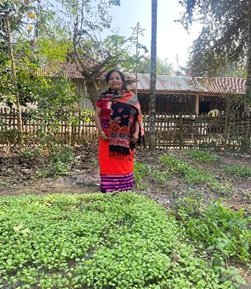
A 47-year-old widowed farmer in Tripura, India, has built a diversified livelihood enterprise across 2.2 acres, combining seasonal vegetables, oyster mushroom cultivation, piggery, fishery, medicinal plants, traditional weaving, and tailoring. Mrs. Arati Debbarma of Rammohon Pujari Para village now reports combined annual returns of approximately 780,000 Indian rupees (roughly AUD 14,000) from mushroom and pig enterprises alone, with further income from crops, fish, and garment sales. She is now planning an eco-tourism offering that integrates her farming systems with tribal cultural heritage.
From Kitchen Garden to Integrated Enterprise
Mrs. Debbarma began with a small kitchen garden more than two decades ago. Diversification was incremental and deliberate: each new enterprise was chosen to complement existing activities, use available land and materials, and generate income at different points in the year.
Oyster mushroom cultivation, undertaken in three annual production cycles using locally sourced inputs, now contributes approximately AUD 5,400 per year based on reported farm-level returns. The piggery, which she has operated for over twenty years and which currently runs four breeding pigs sold as piglets through local channels, contributes approximately AUD 8,600 per year. Neither enterprise requires large land areas. Both run alongside crop and fishery production rather than displacing them.
Technical support from ICAR-Krishi Vigyan Kendra (KVK), West Tripura, a government agricultural extension service, provided capacity building across integrated farming systems, organic production, livestock management, and entrepreneurship. The support was targeted and practical rather than generic.
Cultural Heritage as a Business Asset
Mrs. Debbarma’s most distinctive business decision has been treating traditional knowledge as productive capital rather than background context. She revived traditional tribal weaving of the Rignai garment, added a tailoring unit, and opened a small retail outlet for traditional clothing. These activities generate a separate income stream and directly preserve community craft skills.
That integration of culture into a commercial farming operation is the conceptual foundation for her next step. She is now working toward an eco-tourism model that brings visitors onto the property to experience integrated farming alongside tribal cultural practices, with a stated goal of creating employment for women and rural youth in her community.
What This Means for WA Operators
The transferable lesson here is not the specific enterprises, which are suited to Tripura’s climate, market access, and cultural context, and most are not directly replicable on a WA property. The lesson is structural.
Mrs. Debbarma’s operation succeeds because each enterprise on the property was chosen to do at least two things: generate income and reinforce something else already on the farm, whether that is nutrient cycling, labour scheduling, or cultural distinctiveness. Agritourism was not the starting point. It is the logical endpoint of a property that already had multiple genuine stories to tell.
WA operators planning or refining an agritourism offering should consider whether their visitor experience is built the same way: grounded in genuine on-property production, differentiated by something the operator knows that visitors cannot easily find elsewhere, and structured so that the farming activity and the visitor activity reinforce rather than compete with each other.
The cultural heritage element is worth examining separately. A number of WA agritourism operators hold deep generational knowledge of farming practice, land management, or food production that is commercially underused. Traditional or heritage farming methods, rare breed programs, heritage-variety orchards, and Indigenous land management partnerships are all analogues to what Mrs. Debbarma is doing with Rignai weaving: converting existing knowledge into a differentiated visitor experience that competitors cannot easily copy.
The third observation is about scale. Mrs. Debbarma’s enterprise generates meaningful household income from 2.2 acres. WA operators sometimes defer agritourism development on the assumption that the property is not large or spectacular enough to attract visitors. This case is a useful counterargument. Depth of experience and diversity of activity can substitute for scale.
WAAA is building a peer network, mentorship program, and resource library specifically so WA operators can learn from models like this one without having to find them independently. The association is volunteer-led and early in its development, and the speed at which those resources grow depends directly on operator participation. If stories like Mrs. Debbarma’s are the kind of benchmarking your business would benefit from, membership is the mechanism that makes more of it available.