
The National Farmers’ Federation (NFF) has called on Australian farmers and food producers to pursue formal supply relationships with the cruise shipping industry, following the launch of a national advocacy and commercial linkage campaign called the Australian Paddock to Port Alliance. The campaign was announced in early August 2026.
The Alliance and the Numbers
The Paddock to Port Economic Impact Report, released in early August 2026, puts the cruise industry’s annual economic contribution at more than $7.3 billion and estimates it supports more than 22,000 Australian jobs. Cruise lines spend approximately $1.5 billion in Australia each year across suppliers, service providers, and port operations. Passengers add a further $1.8 billion in shore-side spending on accommodation, transport, dining, retail, and excursions.
NFF CEO Mike Guerin described the financial flow to producers as being “in the order of hundreds of millions of dollars,” driven by cruise ship provisioning requirements for fresh produce, meat, dairy, seafood, and wine. “When ships are provisioned in Australia, they create demand for fresh produce, meat, dairy, seafood, wine and other Australian goods,” Guerin said. “Cruises may start at the port, but the economic activity reaches back to paddocks, processing facilities, transport networks and regional businesses.”
Guerin noted a structural feature of cruise procurement that suits agricultural production planning: cruise lines operate on 12-month forward procurement schedules, providing producers with extended lead time and demand visibility.
Supply Chain Entry Points
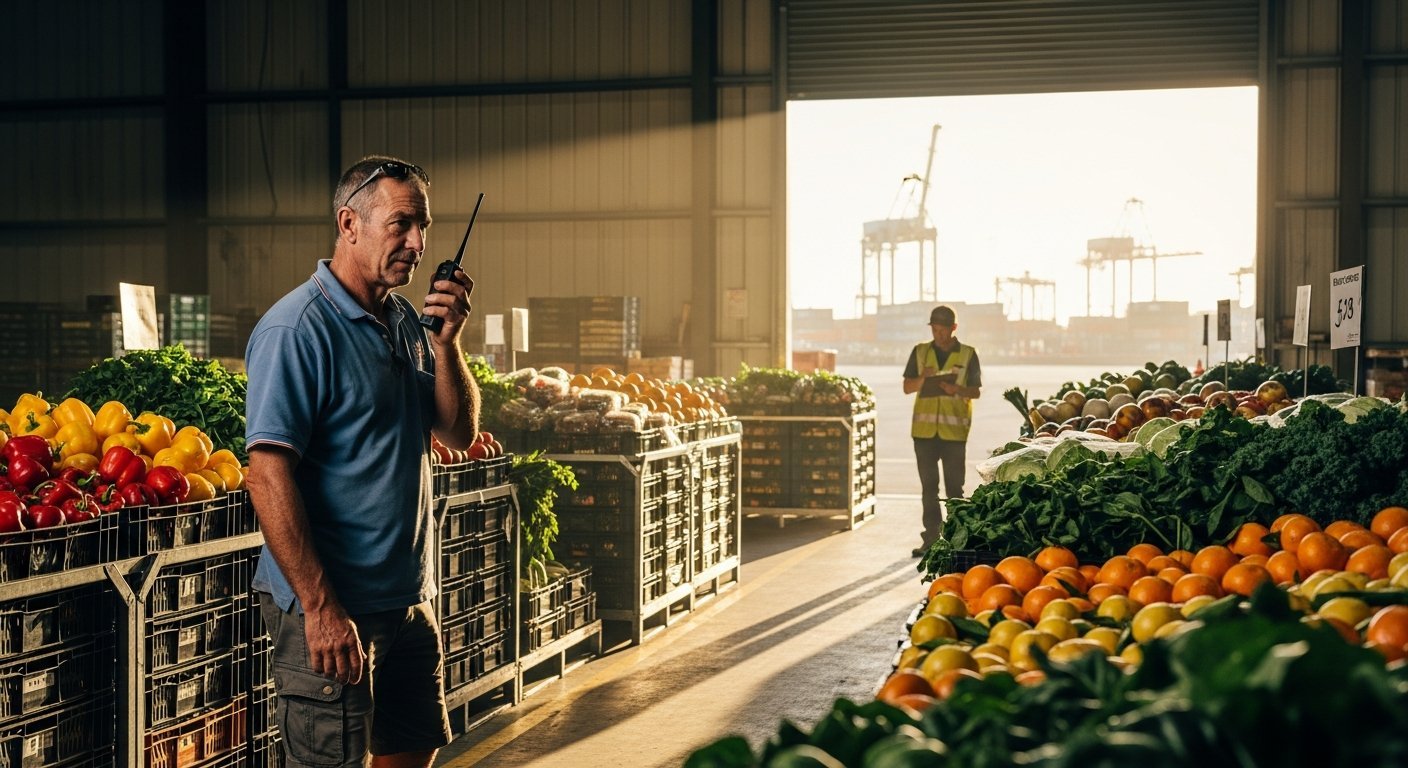
The alliance brings together farmers, food suppliers, tourism operators, ports, and cruise industry bodies. One of its commercial participants is Select Fresh Providores, an Australian fruit and vegetable wholesaler with distribution centres across major capital cities. The company supplies thousands of tonnes of produce to cruise ships and services most major cruise lines operating in Australian waters. For individual producers, wholesalers of this type represent a realistic access point to cruise supply contracts, rather than direct negotiation with cruise lines.
Guerin encouraged producers to focus on building relationships within this supply chain and to ensure their operations can meet the volume, consistency, and food safety requirements cruise lines expect.
Competitive Pressures on the Industry
Cruise Lines International Association (CLIA) executive director Joel Katz flagged that while passenger demand is at record levels among Australians, the sector’s overall economic contribution has declined by close to $1 billion. Katz attributed this to regulatory uncertainty and rising operating costs, warning that Australia risks losing cruise traffic to competing destinations. The alliance is lobbying for stable, practical, and competitive regulatory settings to maintain Australia’s position as a cruise destination.
What This Means for WA Operators
Western Australia holds a practical advantage in this conversation. Fremantle is one of Australia’s active cruise ports, meaning provisioning supply chains already operate in the state. WA agritourism operators who produce or process food commodities, including meat, wine, stone fruit, citrus, or value-added dairy, are geographically positioned to supply into a local distribution network rather than shipping east.
The 12-month forward procurement cycle Guerin highlighted is directly compatible with seasonal farm production planning. Operators who can demonstrate supply consistency, volume reliability, and food safety accreditation are the profile cruise provisioners are seeking.
For operators running on-farm experiences alongside production businesses, there is a secondary angle. Shore excursion spending accounts for a portion of the $1.8 billion passengers spend on land. Agritourism properties within a viable coach or transport distance of Fremantle could explore listing with shore excursion aggregators or directly with cruise line experience teams, though this is a longer-sales-cycle relationship that requires formal trade registration rather than consumer-facing marketing.
Operators considering either the supply or excursion pathway should note that both require engaging with intermediaries, wholesalers and excursion operators respectively, rather than approaching cruise lines directly. The practical first step is identifying which distributors or experience aggregators currently hold cruise line contracts in WA and initiating a trade conversation with those businesses.