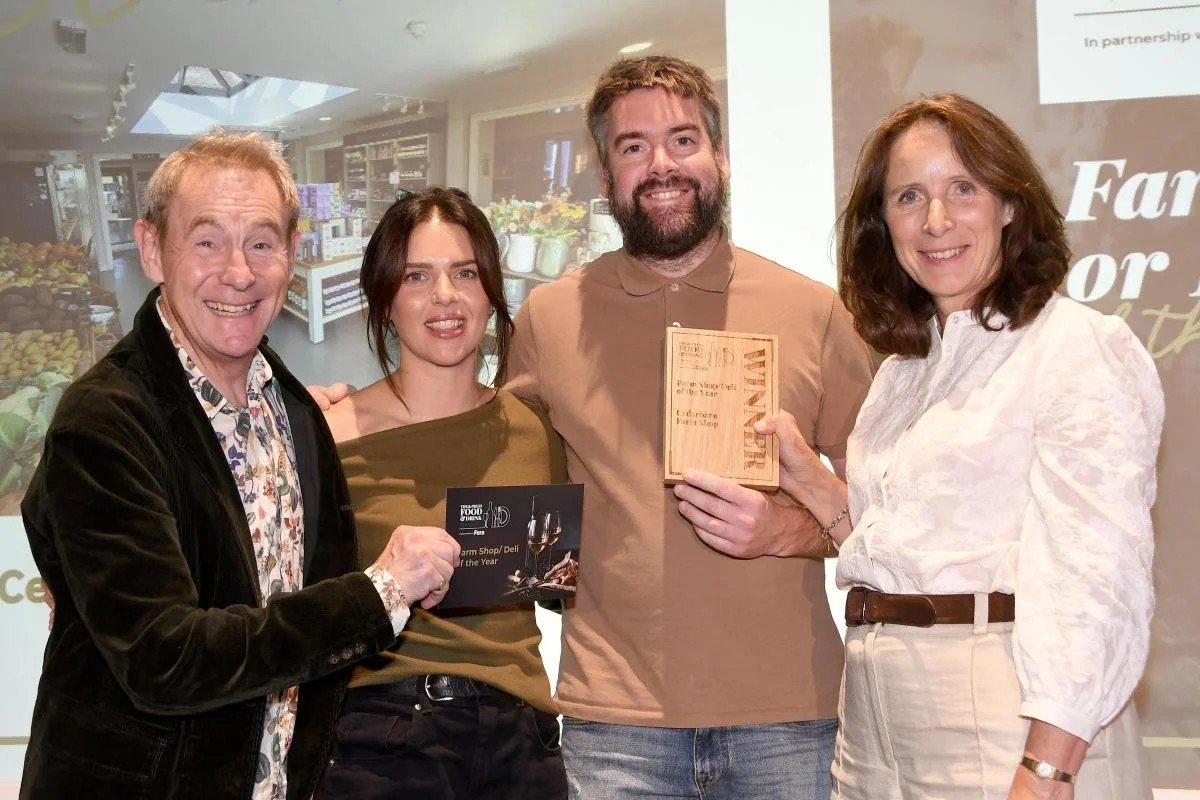
A North Yorkshire farm shop that started as a strawberry-picking caravan in 1995 has taken out the Farm Shop and Deli of the Year title at The Press Food and Drink Awards, held in York on 12 October 2026, demonstrating how a single on-farm product line can be developed over three decades into a substantial rural food business.
Cedarbarn Farm Shop, near Pickering, operates on family land held by the Avison family since 1919. The business now employs 51 people and operates a farm shop, cafe, and miniature railway, having grown from a pick-your-own strawberry venture into what judges described as one of the region’s most significant rural food destinations.
The Business Model
Cedarbarn’s commercial structure is built around a field-to-fork principle, with a substantial portion of produce grown, reared, or manufactured on the property. Product lines include home-grown fruit and vegetables, grass-fed Aberdeen Angus beef, locally reared lamb, and a range of handmade kitchen products. The business supplements its own production with more than 100 local supplier relationships, positioning the shop as a regional food hub rather than a standalone farm outlet.
Judges specifically cited the business’s commitment to provenance, sustainability, and minimising food miles as distinguishing factors. A recently upgraded deli counter and expanded artisan sandwich range have become a reliable revenue stream, drawing traffic from visitors travelling to the North Yorkshire Moors and coast.
Despite what the business described as rising costs and challenging trading conditions, Cedarbarn recorded turnover growth of more than five per cent in the most recent period, while simultaneously investing in new facilities and expanding its deli offering. That combination, growth alongside capital investment, points to a business operating with deliberate reinvestment discipline rather than extracting short-term margin.
What This Means for WA Operators
The Cedarbarn story is worth examining for its growth architecture, not its geography. Several of the structural choices that drove its expansion are directly transferable to a WA agritourism context.
The first is the value of staging diversification over time. Cedarbarn did not open as a 51-person operation with a cafe, deli, and railway. It added complexity incrementally over 30 years, using the cash flow and customer base of each stage to fund the next. WA operators considering whether to add a farm gate store, a cafe, or an experience product can read this as evidence that sequencing matters more than scale.
The second is the commercial logic of stocking local supplier products alongside your own. Carrying more than 100 regional suppliers converts a farm shop from a single-producer outlet into a food destination, which expands the customer demographic and increases average transaction value without requiring the operator to produce everything on offer. In WA, where distances between producers are larger, a curated regional supplier arrangement may require more logistical planning, but the underlying model is sound.
The third is the deli counter as a margin lever. Processed and prepared food, sandwiches, savoury products, and ready-to-eat items typically carry higher margins than raw primary produce. Cedarbarn’s recent investment in its deli offering, and the positive revenue response, reinforces what many WA farm gate operators already know: the more a product is transformed before it leaves the property, the more value is captured on-farm.
The miniature railway is worth noting as a standalone point. It functions as a footfall driver that extends dwell time and creates a reason for repeat visits beyond the food offering. WA operators with sufficient land and capital may find a comparable experience anchor, whether a working machinery display, a guided farm walk, or an animal encounter, performs a similar commercial function.
WAAA is building the peer network and resource library that would allow WA operators to map their own diversification pathways against case studies like this one. That work depends on member participation. If your operation is at a decision point about what to add and when, the WAAA member forum and mentorship program are the practical places to work through it with people who have done it in a WA context.