
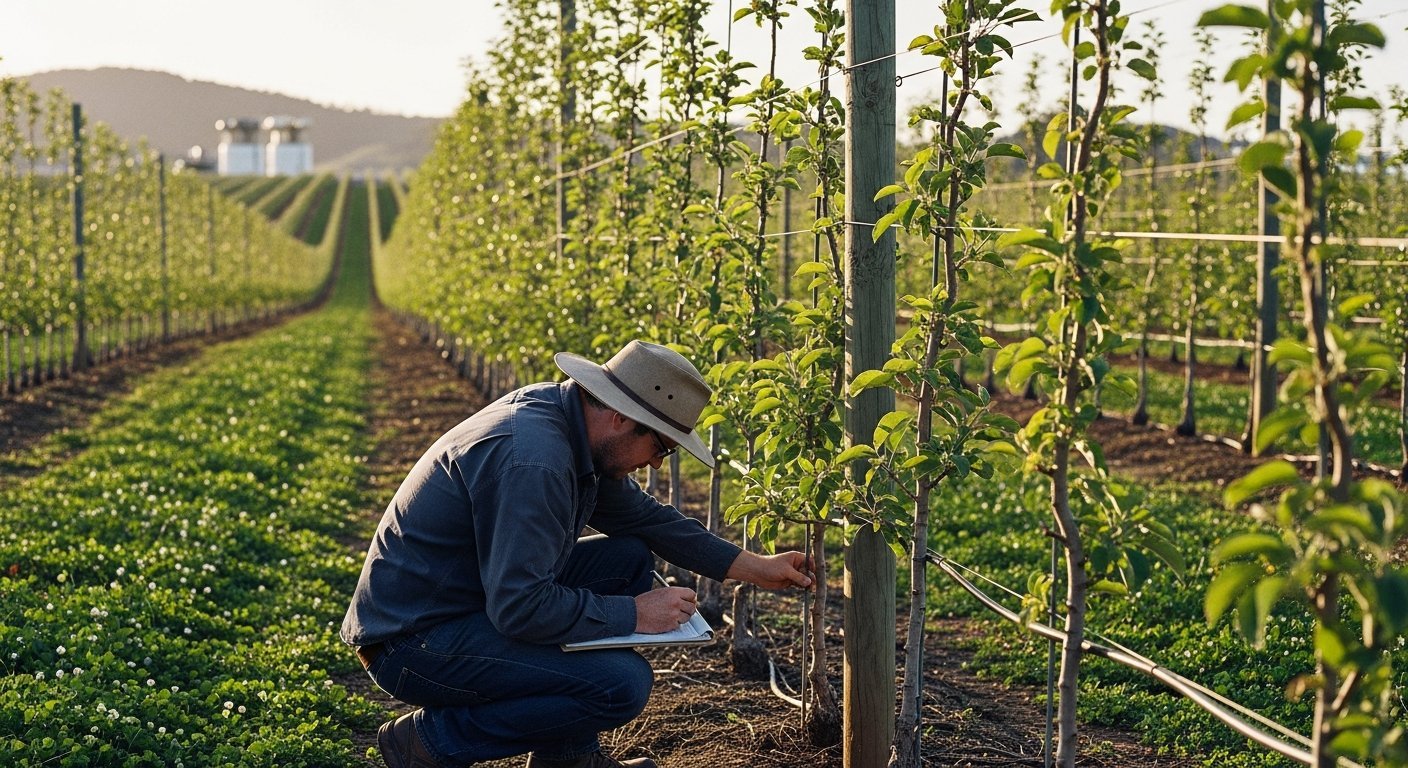
Western Australian apple and stonefruit growers received a direct briefing on the latest findings from a national five-year research program aimed at reducing production costs and improving fruit consistency, at a field day held on 21 May 2026 at the Manjimup Horticulture Research Institute.
What Was Presented
The Department of Primary Industries and Regional Development (DPIRD) hosted its ‘Apples for the Future’ field day, drawing more than 30 growers to its Manjimup research site. The event centred on DPIRD’s contribution to Hort Innovation’s Narrow Orchard Systems for Future Climates project, a nationally co-funded initiative now in its second year of a five-year program.
The research is testing three apple cultivars grown on three different rootstocks, trained into a vertical two-dimensional fruiting wall. The design targets improved light penetration, airflow, and canopy uniformity, with the stated objective of producing more consistent, high-quality fruit while reducing management and harvest complexity.
Key Findings to Date
DPIRD research scientist Dr Asad Ullah presented year-two data from the trial site. The findings so far indicate:
- Rootstock selection is the single most significant variable in early tree growth performance.
- The most vigorous semi-dwarfing rootstock is producing strong vertical shoot growth across all cultivars tested.
- Year-one training focused on establishing two horizontal branches (cordons); year-two work has shifted to developing vertical growth from those cordons.
- Strong early canopy fill from vigorous rootstocks may accelerate production timelines, but carries a likely trade-off of higher pruning and maintenance requirements in subsequent seasons.
Data collection continues through to the end of the second growing season. An economic analysis examining establishment costs, operating costs, fruit yield, quality, and harvest efficiency is underway and will be published to support grower investment decisions.
Scope Beyond Apples
While the Manjimup trial is apple-focused, DPIRD has confirmed the canopy management outcomes are transferable to cherries, plums, apricots, and selected tropical species. The field day also included presentations from Agriculture Victoria on pome and stonefruit trials, the South Australian Research and Development Institute on apricot and cherry data, and the New Zealand Bioeconomy Science Institute on cherry trials. An ag-tech demonstration covered an electric orchard management platform and orchard management sensors.
Strategic Implications for Operators
For growers evaluating capital investment in orchard redevelopment or new plantings, the economic analysis component of this project is the most commercially relevant output to monitor. When published, it will provide independent, trial-based cost-benefit data on narrow orchard establishment versus conventional systems — a more reliable basis for investment decisions than supplier projections.
The rootstock findings are immediately actionable for growers planning new blocks: the vigorous semi-dwarfing rootstock data suggests a faster path to canopy establishment and early cropping, but operators should model higher ongoing maintenance costs before committing at scale.
Funding and Project Partners
The Narrow Orchard Systems for Future Climates project is funded through the Hort Frontiers Advanced Production Systems Fund, a Hort Innovation initiative, with co-investment from Agriculture Victoria, NSW Department of Primary Industries and Regional Development, the South Australian Research and Development Institute, DPIRD WA, the University of Queensland, the New Zealand Bioeconomy Science Institute, Pomewest, Tobias Industries, and the Australian Government.
Further information on DPIRD’s contribution to the project is available on the DPIRD Narrow Orchard Systems webpage.
The WAAA News Team