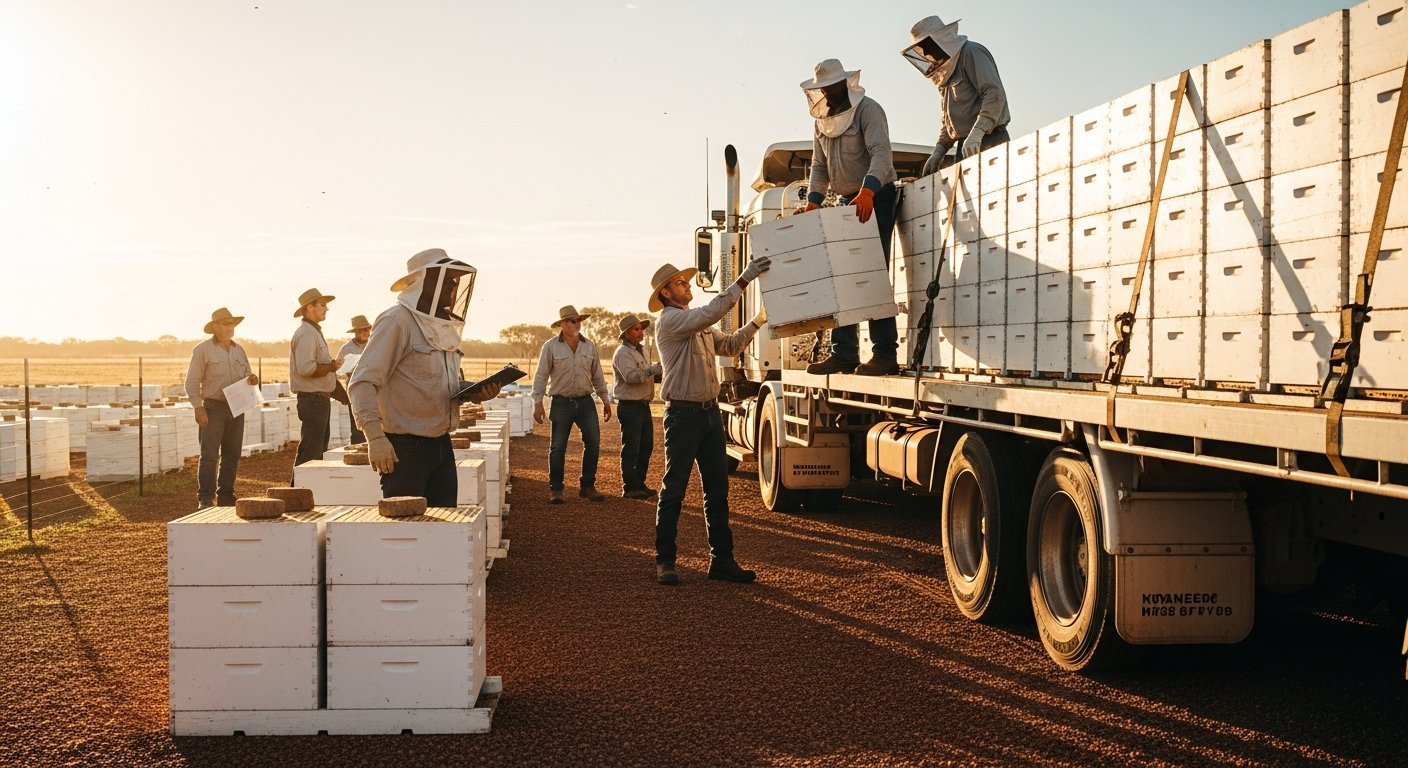
More than 7,500 Western Australian beehives are being transported to South Australia to provide emergency pollination services for the almond industry, in a commercial deal worth more than $2.3 million. The shipment, coordinated across collection points in Donnybrook, Gingin, and Esperance, represents the largest known interstate movement of WA bees in response to varroa mite devastation in the eastern states.
Five prime mover road trains are involved in the operation, with three having already crossed the South Australian border as of 26 July 2026. The hives were purchased by a single commercial almond grower at $350 per hive, with timing calibrated to coincide precisely with the opening of almond flowers. A dozen WA beekeepers participated in the collection phase.
Commercial Context for Agritourism and Pollination-Dependent Operators
For WA agritourism operators whose businesses depend on pollination services — including orchards, berry farms, and flowering crop enterprises — this deal signals a significant shift in the national pollination market. With wild and managed bee colonies across New South Wales, Victoria, and South Australia continuing to collapse under varroa mite pressure, WA’s biosecurity status has become a direct commercial asset.
The hives delivered to South Australia will not return. Beekeeper Steve Sammut, who coordinated logistics for the operation, confirmed the transported colonies will eventually succumb to varroa mite once in the affected zone. The deal is a one-season commercial arrangement, not a sustainable supply model.
Biosecurity Risk Remains the Critical Variable
WA currently remains free of varroa mite, but beekeepers are warning that this status cannot be taken for granted. The variant now circulating in eastern states has been described by industry participants as carrying secondary viruses, resulting in the complete loss of entire apiaries rather than gradual colony decline. Sammut referred to it as a “super mite” for this reason.
The WA government cited the interstate shipment as evidence of its biosecurity program’s effectiveness. That position has been disputed by at least one industry participant, who stated publicly on 26 July 2026 that the Department of Primary Industries and Regional Development (DPIRD) lacks the staffing and budget to adequately inspect incoming material. The implication for operators relying on hired pollination services or maintaining on-site hives is clear: the current biosecurity buffer is under-resourced relative to the threat level.
Operational Implications for Agritourism Businesses
Operators who use managed beehives for crop pollination, honey production, or visitor experience programming should note the following:
- The eastern states pollination shortfall is expected to persist beyond the current almond season, given that colony losses are ongoing and varroa mite has no confirmed eradication pathway in affected regions.
- Demand for WA-sourced hives is likely to increase, which may affect hive availability and pricing for local operators seeking pollination contracts in future seasons.
- Any WA operation importing plant material, soil, or equipment from eastern states should review incoming biosecurity procedures, given industry concerns about DPIRD inspection capacity.
- Operators running apiary-based visitor experiences or educational programs should document their hive health and maintain records that would support rapid response if varroa mite is detected in WA.
The previous trial that preceded this deal involved 600 hives transported in approximately July 2025. The scale increase to 7,500 hives in 2026 reflects both growing eastern states demand and the improving hive productivity among WA beekeepers following favourable seasonal conditions in late 2025.