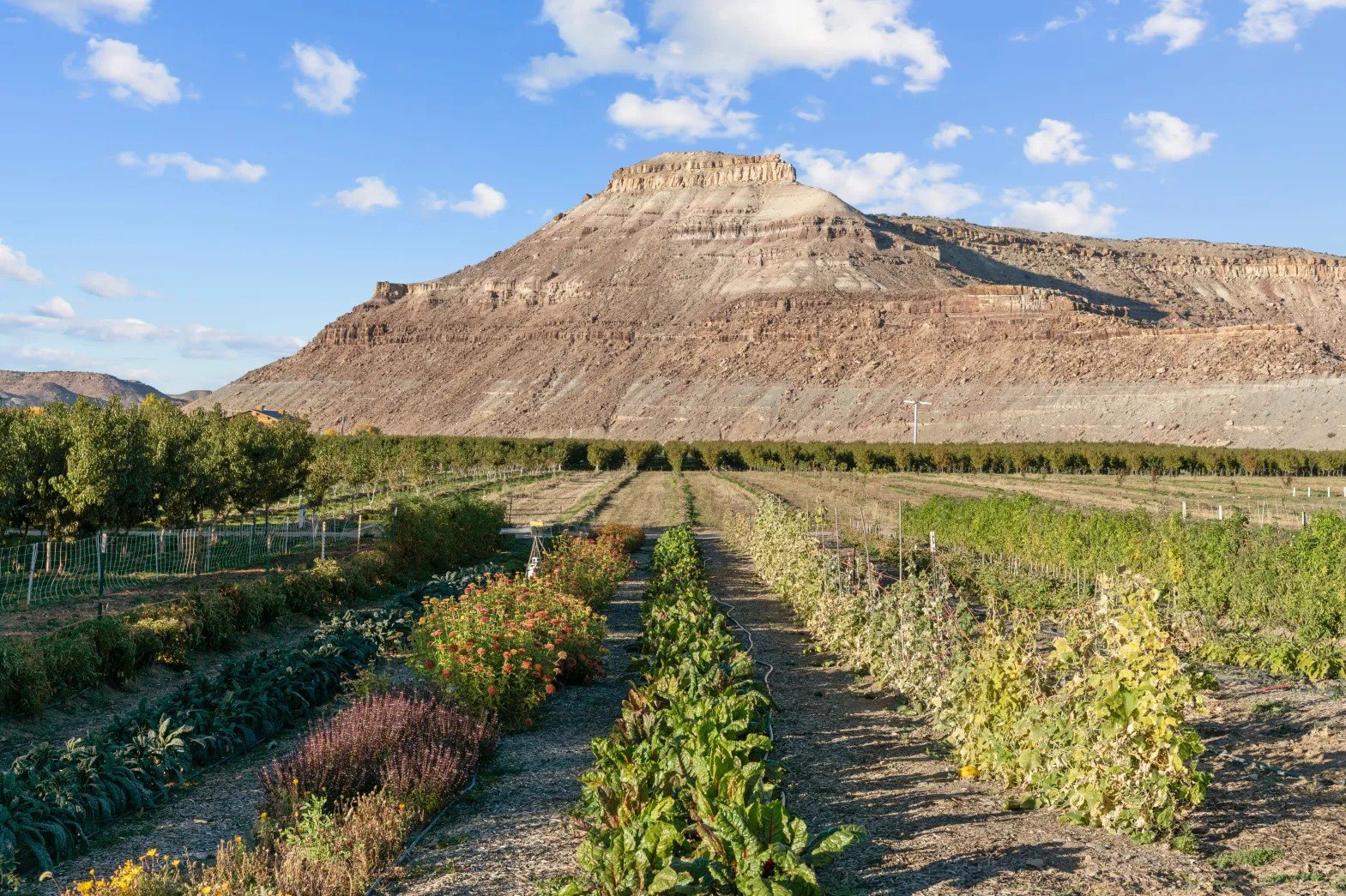
A late spring freeze in 2026 wiped out the entire cherry, peach and pear crop at Honey Rock Landing in Delta, Colorado, destroying an estimated $300,000 in produce. The farm survived the loss because its revenue base had already been diversified into lodging, events, and hospitality. The case is one of several from Colorado’s Western Slope that illustrate how agritourism functions as a financial buffer against production failure, a tool for business succession, and an economic anchor for rural communities.
Crop Failure as the Catalyst
Honey Rock Landing’s owners, Leslie and Colby Barrett, began investing in agritourism after purchasing the 77-acre orchard property in 2018. They developed cave suites built into sandstone rock formations, a special events venue, and a gift shop. When the 2026 freeze eliminated you-pick and farmers market income entirely, those non-agricultural revenue streams kept the business operating. In response to the lost season, the farm introduced free Friday afternoon open hours, ticketed specialty dinners, and wine pairing events through its onsite kitchen.
Sales and hospitality manager Erica Frank was direct about the financial reality: “Farming does not pay the bills. The only thing making money on this farm right now is the suites and these events.”
The model reflects a pattern seen across Colorado. According to the 2022 United States Department of Agriculture census, approximately 900 farms in Colorado reported agritourism income that year, generating $66.7 million combined.
Incremental Build, Not Wholesale Reinvention
Billy Goat Hop Farm in Montrose entered agritourism in 2025 following a difficult 2024 harvest marked by crop mites, poor weather, rising labour costs, and declining beer sales across the sector. Co-owners Audrey Gehlhausen and Chris Della Bianca did not overhaul the business in one move. They built a single small shed fitted with kegerators to serve craft beers made from their own hops, then designated roughly a dozen campsites with basic amenities including showers and flushing toilets.
The expansion was staged. After the initial setup drew consistent traffic from local drinkers and travelling campers, the pair invested further in 2026, adding glamping units and repurposed grain silos as shade structures and a permanent stage for live music. Gehlhausen described the progression as organic, with each reinvestment funded by the revenue already generated.
The farm’s agritourism income now runs concurrently with the growing season, addressing a cash flow gap that purely agricultural operations in the sector routinely face. The couple is now evaluating a permanent taphouse as a longer-term infrastructure investment.
Organic Growth from Community Curiosity
Elevation Mountain Grown Herbal Tea in Hotchkiss began as a wholesale-only operation on a 5-acre property in 2018. Owner Shannon Ullmann’s shift to agritourism was not planned. Neighbours and friends expressed repeated interest in the growing and blending process, prompting her to open during local events such as the Colorado Lavender Festival. Scheduled public visits followed, and by 2026 she had added a dedicated flower garden to support you-pick sessions and bouquet-making classes. The farm also offers painting classes and a retail store selling tea, honey, and Ullmann’s own photography.
Wholesale revenue still represents approximately 60% of the business, but that proportion is shifting as visitor-facing income grows. Ullmann noted that agritourism has become a meaningful part of the broader economic recovery of the North Fork Valley, which lost significant employment as coal mining operations declined after 2015. Small farm tourism has partly filled that gap, alongside emerging businesses in lavender, tallow production, and wine.
Succession and the Generational Argument
James Ranch in Durango, a 400-acre operation running 200 head of cattle and an active dairy, illustrates how agritourism can anchor the next generation to a family property. The ranch’s five siblings all left as young adults before gradually returning, each adding a distinct business function: organic vegetable growing, regenerative farming documentation, artisan cheese production, and ultimately a grill and market opened by Cynthia James Stewart in 2019 to sell the family’s own beef, produce, and dairy directly to customers.
The ranch now offers self-guided regenerative farming tours, daily milking viewings, and children’s programming. The model has extended into the following generation. James Stewart’s nephew runs a homesteading camp, and his brother is expected to take over the beef operation within the next two years.
The Colorado Agritourism Association’s executive director, Corry Mihm, framed the succession case in economic terms. The USDA reports the average age of Colorado farmers at 58.3 years. Farms with consumer-facing agritourism operations bring in an average of $73,000 annually from those activities. Mihm’s assessment: “When you think about that in a small rural area, that means maybe one of the kids could afford to stay and live there and raise a family and reinvest in the community.”
What This Means for WA Operators
The Colorado examples do not describe a new concept for Western Australian operators. Diversification across accommodation, events, and direct retail is already standard practice for many established agritourism properties in the South West, Great Southern, and Peel regions. WA operators have also been managing the financial volatility of climate-driven crop failure, water constraints, and seasonal variability as a business baseline for decades.
That said, three practical points from the Colorado cases are worth examining directly.
The first is the staged infrastructure approach used by Billy Goat Hop Farm. The decision to build incrementally, using early agritourism revenue to fund the next phase rather than committing to large upfront capital, reduces exposure if visitor demand does not materialise as projected. Operators considering new accommodation or events infrastructure may find this sequencing useful, particularly given current construction costs in regional WA.
The second is the revenue floor argument. The Colorado Agritourism Association cites an average of $73,000 annually from visitor-facing activities across farms with agritourism income. That figure is a useful benchmark when evaluating whether an existing WA property’s agritourism component is performing at or below its potential, or when building a business case for expanded investment.
The third concerns succession. The James Ranch example is directly relevant to WA’s family farm context. Where a property can offer a younger family member a distinct, financially viable business role within the agritourism side of the operation, such as events management, accommodation, or a farm gate retail function, it creates a credible economic reason to return that traditional farming income alone may not provide. WA operators who are thinking about transition planning may find it worth mapping whether their current agritourism structure creates such a role, or whether it could with targeted investment.