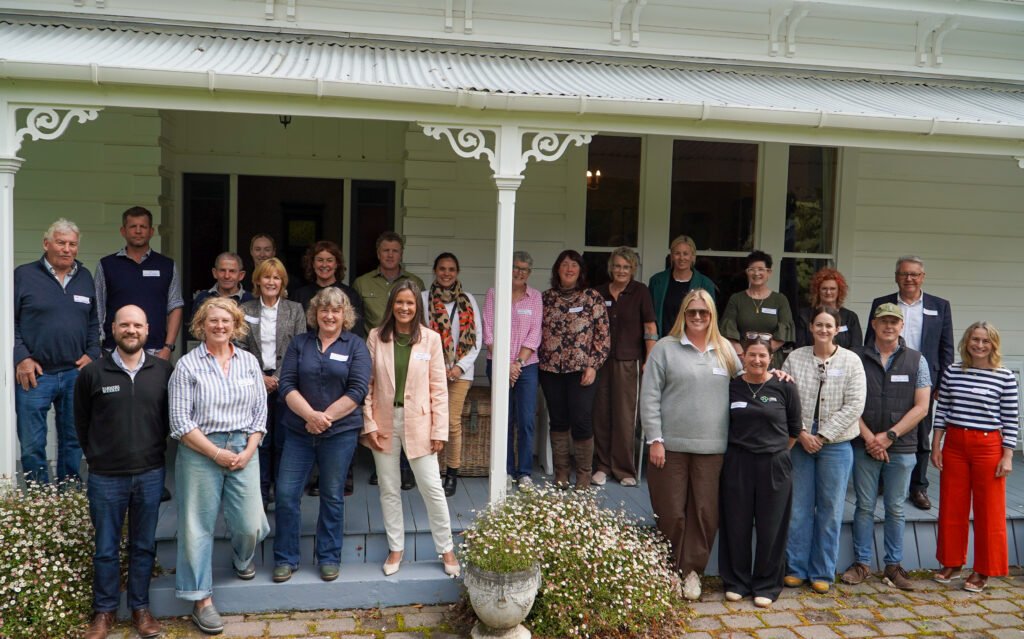
A third regional agritourism network launched in New Zealand on 27 October 2026, with the Manawatū-Whanganui network joining two existing clusters under the national Agritourism NZ umbrella. The launch, held at Romney Lane Homestead and Grassmere Estate, brought together sheep and beef farmers, berry growers, and rural art studio owners alongside local council representatives.
How the Network Model Works
Agritourism NZ was founded by Marijke Dunselman and describes itself as New Zealand’s only organisation dedicated solely to agritourism. It operates through regional networks, of which the Canterbury-Marlborough and Otago-Southland networks launched first in 2025.
Each regional network offers members:
- Two on-farm meetings per year
- Two online “Power Hour” sessions per year
- Access to an ongoing online discussion forum
The model is explicitly designed to create geographic clusters of agritourism businesses, with the stated goal of giving visitors a denser, more connected set of experiences within a single region, which in turn supports the commercial case for them to travel there. Manawatū-Whanganui network co-leader Steph Strahan described the aim as building “clusters of agritourism businesses together to provide better experiences.”
One attendee, glass studio owner Carmen Simmonds, noted she had never previously identified her rural business as agritourism despite drawing international visitors from Canada, the United States, Australia, and the United Kingdom. Her case illustrates a pattern relevant to any rural operator: businesses with an experiential, on-property offering may already qualify as agritourism without having positioned themselves that way or accessed the marketing and peer-support benefits that come with formal sector membership.
What This Means for WA Operators
The Agritourism NZ model is a direct structural parallel to what WAAA is building in Western Australia, and the New Zealand experience offers a few concrete observations worth noting.
The cluster strategy is the most transferable element. Agritourism NZ’s regional networks are built on the premise that a group of nearby operators, promoted together, generates more visitor traffic than each operator promotes alone. In WA, where properties are often separated by significant distances, strict clustering by postcode is less practical than in New Zealand’s smaller regions. However, the principle of coordinated, sub-regional promotion (for example, grouping operators in the South West, Great Southern, or Avon Valley) remains valid and is something WAAA is positioned to facilitate as membership grows.
The meeting cadence is also instructive. Two on-farm visits and two online sessions per year is a deliberately low-commitment format that keeps volunteer energy sustainable while still maintaining genuine peer contact. WAAA’s member forum and networking events follow the same logic. Operators who have not yet joined should understand that the time ask is modest and that the forum is active now.
The Carmen Simmonds example is a prompt for WA operators to audit their own positioning. If your property receives paying visitors for any on-farm experience, whether a cooking class, a farm walk, a harvest event, or a rural art studio, you are operating in agritourism and the sector’s support structures are available to you.
Finally, the New Zealand story is honest about scale. Agritourism NZ is still small, still building toward being fully farmer-led, and still expanding its network coverage. WAAA is in the same position. The way both organisations accelerate is through operators joining and participating, not through waiting for the body to grow before engaging with it.