
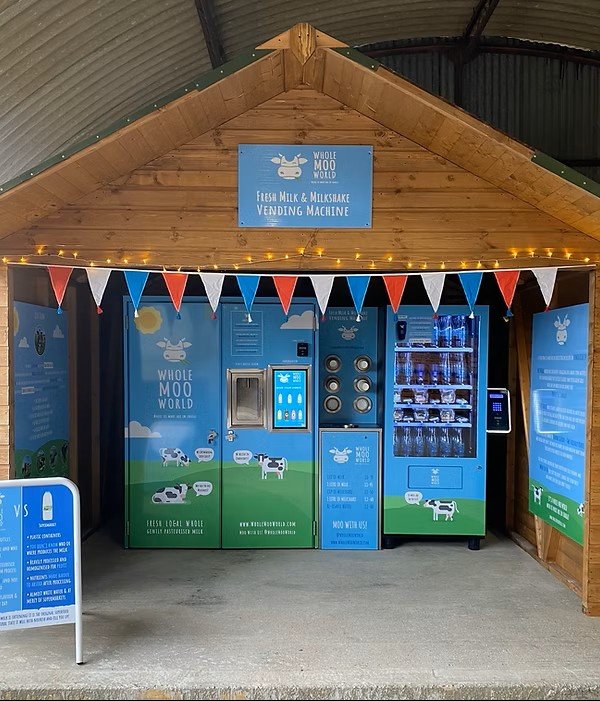
A Herefordshire dairy operation has restructured its revenue model by routing nearly a third of its daily milk production through a network of 17 refrigerated vending machines, bypassing processor pricing and setting its own farm-gate retail price for the first time in the business’s history.
The Operation and Its Structure
The James family, trading as Whole Moo World, runs 130 dairy cows on a property in Bodenham, Herefordshire, producing 4,500 litres per day. Of that volume, approximately 1,350 litres now sells through 17 refrigerated vending cabinets located across Herefordshire, Gloucestershire, Worcestershire and Shropshire. The remaining 70 percent continues to move through a local processor under conventional supply arrangements.
The machines operate without staff, without fixed trading hours, and without a shopfront. Mark James, 70, who farms alongside sons Sam, 39, and Jacob, 36, describes the shift as moving from price taker to price maker, and has stated that without the machines the family would have considered exiting dairy production entirely.
The Second Revenue Layer
The James siblings built a second business, Tuckshop, on top of the vending infrastructure. Operating from 22 sites, mostly co-located with the milk machines, Tuckshop retails products from local small producers including scotch eggs, sausage rolls, brownies and sandwiches. The operation also recovers and resells the glass bottles used for milk, completing a circular packaging loop that reduces per-unit packaging cost and supports the brand’s positioning.
This layering approach means the physical footprint of each vending location generates income from two separate product categories, improving the return on site leases or land agreements without requiring additional staff at any individual location.
The Margin Logic
Jacob James argues the vending format suits rural locations that cannot sustain the footfall required for a traditional farm shop or the capital outlay of a staffed retail fit-out. The core commercial argument is straightforward: direct sales capture the retail margin that would otherwise sit with a processor or distributor. For a commodity like raw milk, where processor payments can sit at or near the cost of production, that retail margin is the difference between viability and exit.
A 2024 study published in Applied Geography identified 13.8 million people in the UK as living with limited access to grocery retail. The James family’s model addresses that access gap as a commercial opportunity rather than a philanthropic one, placing product where demand exists but supply infrastructure has withdrawn.
What This Means for WA Operators
The transferable lesson here is not the vending machine itself but the underlying pricing logic: structured direct sales as a mechanism for escaping commodity-price dependence.
WA agritourism operators, particularly those running farm-gate or on-property sales alongside visitor experiences, already operate in a version of this model. The question the James family’s example raises is whether that direct-sale channel is being used at sufficient scale and in sufficient locations to materially shift revenue away from wholesale pricing.
A few specific considerations worth examining:
- Refrigerated vending technology is commercially available in Australia and is already used in some metropolitan and peri-urban fresh produce and dairy contexts. Operators in regions with consistent passing traffic, such as those near wine routes, coastal highways, or tourist corridors, may find the capital case worth modelling.
- WA’s food licensing and dairy regulations govern the sale of raw and minimally processed milk products. Any operator considering a similar machine-based direct sales model would need to confirm current compliance requirements with the Department of Health WA and Dairy Achieve before deploying equipment, as these differ materially from UK rules.
- The co-location model, placing a second product category alongside a primary one to improve site yield, is directly applicable to WA operators who already have high-traffic on-property points of sale. A honey producer running a roadside stall, for example, could examine what complementary local producer lines would generate return from the same physical location without proportional increases in staffing cost.
- The 70/30 split between processor and direct-sale volume is a useful benchmark. Operators who currently move all or nearly all of a commodity product through wholesale or aggregator channels could assess what proportion of output a direct-sale format could realistically absorb, and what the margin difference per unit would be at current retail prices.
The James family’s experience will not map directly onto most WA properties, particularly those in lower-traffic locations or those not producing a daily-volume commodity. The margin case for vending infrastructure weakens considerably without consistent throughput. But the pricing principle, that direct-to-consumer sales are the primary remaining margin in tight-commodity categories, is well established in WA agricultural economics and this case reinforces why operators should treat direct-sale infrastructure as a strategic asset rather than a secondary income stream.