The Department of Primary Industries and Regional Development (DPIRD) confirmed on 30 July 2026 that its skeleton weed winter eradication program is actively underway, with favorable rainfall conditions supporting herbicide treatment across more than 8,000 hectares scheduled for treatment between May 2026 and August 2026. The program spans properties from Northampton to Esperance and is funded through grower contributions via the Grain, Seeds and Hay Industry Funding Scheme.
Operational Scope and Treatment Method
Skeleton weed is a declared pest that directly competes with crops for nitrogen and soil moisture, reducing both yield and grain quality. DPIRD program manager Martin Atwell confirmed that winter treatment — targeting the weed at the rosette stage — is the most effective eradication method because herbicide applied at this growth stage penetrates deep into the root system, preventing re-establishment. Treatment applied before the plant develops a deep root system may require only one or two applications to achieve elimination.
The 8,000-plus hectares currently under treatment were identified and mapped during the 2025-26 summer searching campaign, which covered more than 300,000 hectares across 700 properties. A digital mapping application, introduced during the prior season, was used by landholders to record search activity and map infestations, streamlining the auditing process.
Drone Surveillance and Precision Detection Technology
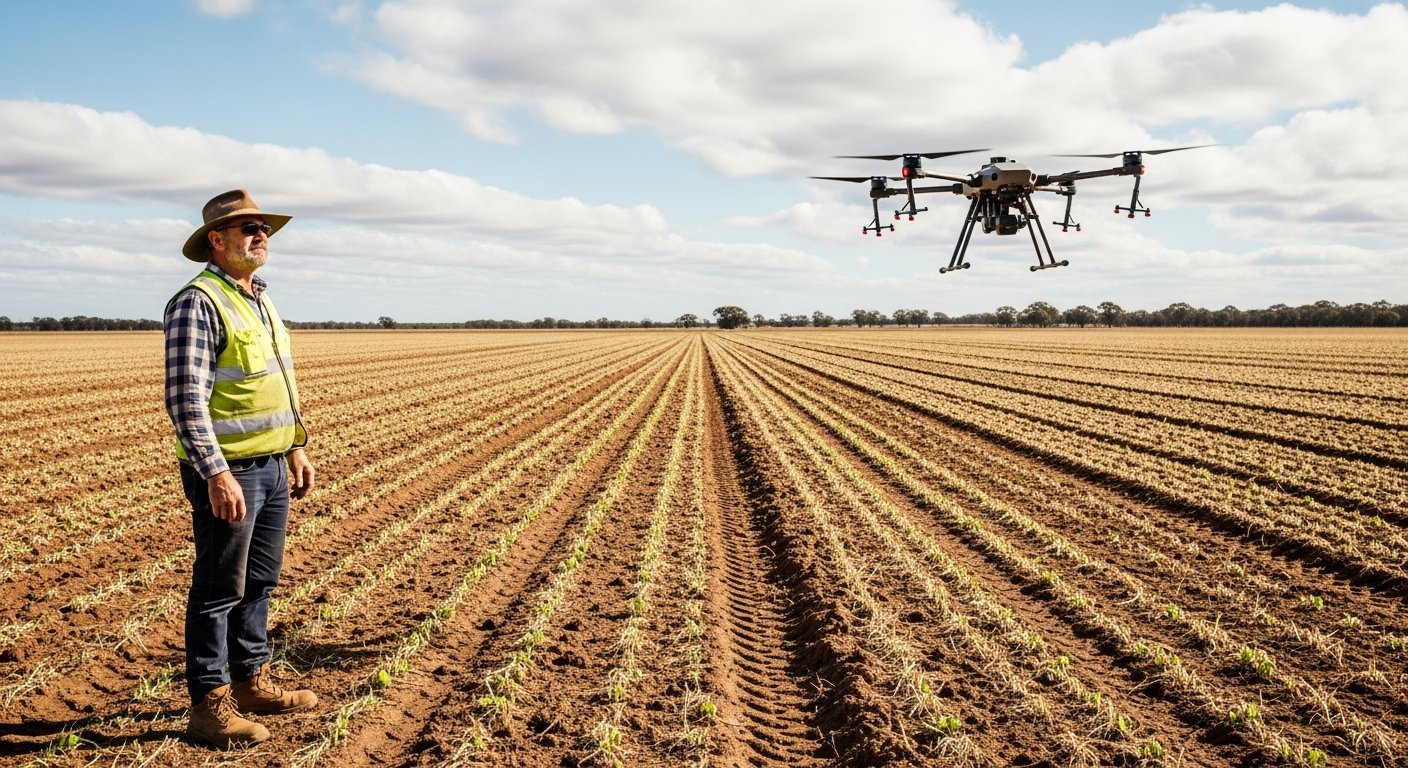
DPIRD is deploying advanced drone surveillance technology developed through a collaboration with the Australian Plant Phenomics Network (APPN). The system uses a high-resolution camera capable of capturing images at two millimetres per pixel; sufficient resolution to identify individual skeleton weed plants. Critically, image processing occurs in the field rather than post-flight, accelerating the identification of infestations and enabling faster deployment of control measures.
Key performance metrics from the trial:
- Coverage rate of up to 500 hectares per day per drone
- Two-millimetre-per-pixel image resolution for individual plant identification
- In-field automated image processing, reducing the lag between detection and treatment
- Improved access to difficult terrain, including bushland, where ground-based searching is impractical
- Reduced false-positive rates through rapid on-site verification
DPIRD project officer Carlos Babativa-Rodriguez stated that the technology enables surveying of suspected infestation areas before the weed becomes established — a capability that materially improves eradication probability and reduces the number of treatment cycles required.
Summer Searching Application Under Investigation
DPIRD is also evaluating whether the APPN drone camera system can be deployed for summer searching of infested paddocks to identify skeleton weed rosettes prior to harvest operations. This would allow infestations to be located and recorded before the header enters the paddock, further accelerating the detection-to-treatment pipeline.
What This Means for Grainbelt Operators
For grain producers operating across the Northampton-to-Esperance corridor, the immediate operational implications are:
- Landholders with properties scheduled for treatment between May 2026 and August 2026 should confirm their inclusion in DPIRD’s current treatment schedule.
- Properties identified during the 2025-26 summer searching campaign as having new or suspected infestations are prioritized for winter treatment — early-stage infestations treated now may require significantly fewer herbicide applications to achieve eradication.
- Landholders may be eligible for financial assistance with winter treatment costs under the Skeleton Weed Program assistance plan. Contact DPIRD directly to confirm eligibility and access details.
- The digital mapping application used during summer searching represents a compliance and auditing tool — operators who have not yet adopted this system should engage with DPIRD before the next searching season.
Grainbelt operators who suspect new skeleton weed infestations on their properties should report them to DPIRD promptly. Program data confirms that early detection and reporting are directly correlated with reduced treatment cycles and faster progression toward property-level freedom from the weed.